
September 25, 2025
AI Agent Monetization: Lessons from the real world
Introduction
In a recent (September 2025) highly insightful session delivered by pricing consultants, Simon‑Kucher, we gained many insights into how agentic AI services are being monetized. The presenters described how established software pricing models (seat‑based licenses) are giving way to usage‑based and outcome‑based pricing for AI agents. They used examples like Intercom, Inc.’s Fin AI agent and compared them with other AI‑enabled services to illustrate how pricing metrics should reflect the level of human augmentation/automation and the tangible value delivered. Below is a synthesis of the key themes from the talk followed by research on the companies mentioned.
Summary of key takeaway points
Intercom’s Fin AI agent as an example of outcome‑based pricing
- Early success: Intercom packages its Gen‑AI agent (Fin) as part of its support suite. Fin resolves customer support tickets using generative AI and is charged per successful resolution rather than per user. According to Intercom’s help page, customers pay US $0.99 per resolution, and a resolution is defined as the user confirming that their question is answered or leaving without asking anything further. This model encourages adoption because customers only pay when Fin delivers value.
- Adoption growth: The presenters noted that Intercom’s outcome‑based model has driven adoption; within five months, the share of support tickets handled by Fin increased from 15 % to 45 %, illustrating how tying price to outcomes aligns incentives.
Shift toward usage‑based and outcome‑based pricing
- Rising popularity: A survey presented in the session showed that ~39 % of respondents expect to monetize AI via outcome‑based pricing, ~36 % via usage‑based metrics, and ~39 % via hybrid approaches. The presenters argued that hybrid‑based models better match the variable cost of running AI than user‑based licenses. read more.
- Price model matrix: Simon Kucher proposed a matrix that positions pricing metrics along two dimensions: human augmentation vs. automation and tangible value delivery. At low automation and low measurable value, user‑based pricing (per seat) is typical (e.g., Grammarly, ClickUp). At high automation and high tangible value, outcome‑based metrics become appropriate (e.g., Intercom Fin, Zendesk’s automated resolutions, AirHelp compensation services). Between these extremes lie usage‑based models such as per‑event, per‑search or per‑token pricing (e.g., Cohere, Algolia, PagerDuty).
- Choosing a price metric: Before selecting a metric, companies should ask two questions: (1) Is the AI product augmenting or automating the user? and (2) Does it deliver measurable and tangible value? Products that strongly automate workflows and have clear value creation are good candidates for consumption or outcome‑based metrics; those that merely augment users may still fit a seat‑based model.
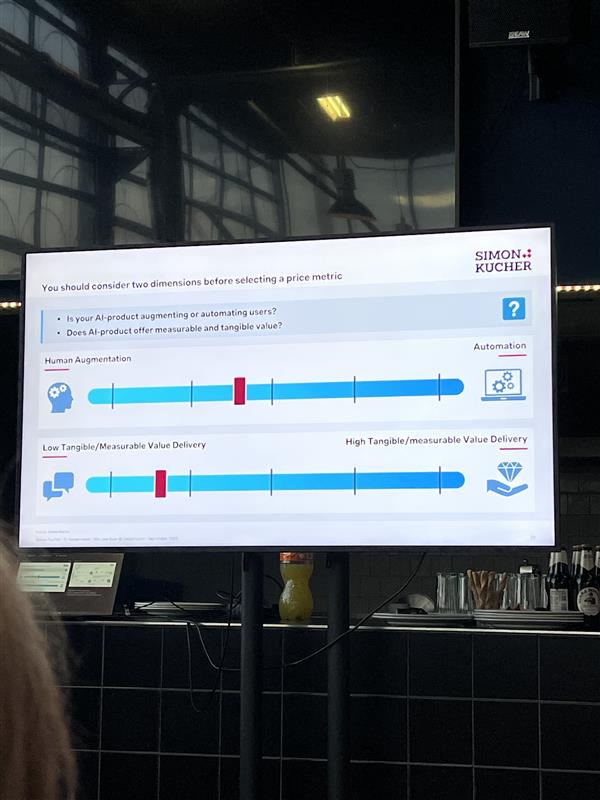
Credit: Presented in September 2025 by Simon Kucher on the AI agent price-value matrix (apologies for the poor quality photo).
Packaging strategies for agentic AI
- Security and compliance fencing: Enterprise customers have higher willingness‑to‑pay for stronger security features. The session gave Anthropic as an example, in its enterprise plan it offers enhanced security features (SSO, RBAC, audit protocols) and private data handling, differentiating it from a team plan. The approach here is using the standard “good‑better‑best” structure where higher tiers provide private data regions, no data retention, and robust access control.
- Specialization fencing: Companies can differentiate plans by the breadth of domain expertise offered. For instance, Sintra offers a package with a generic agent and a higher‑priced package that includes specialized agents for legal, finance, support and technical domains. Customers pay more for access to a suite of domain‑specific agents that cover more use‑cases.
- Autonomy fencing: Another lever is the level of agent autonomy. Devin (Cognition) positioned its most capable version to include automation tools which are only available in enterprise plan. Lower‑tier plans react to prompts or perform single tasks, whereas premium plans allow the agent to plan, use tools, and execute end‑to‑end workflows without human input.
- AI‑centric value drivers: As AI becomes central, packaging should emphasize new value drivers as traditional feature checklists matter less than these AI‑centric attributes:
- System of engagement (how the agent interacts with users, such as chat vs. autonomous workflows)
- Domain expertise
- Trust/governance (security, fairness, data privacy).
AI agent monetization scenarios
Outcome‑based pricing examples
Intercom Fin (B2B support agent)
Pricing model: Fin is available on any Intercom plan and customers pay US $0.99 per successful resolution.
Implications: Outcome‑based pricing ties revenue to resolved tickets and encourages users to let Fin handle more conversations.
Chargeflow (chargeback management)
Pricing model: Chargeflow’s success‑based pricing is 25 % of the value of each successfully settled chargeback; there are no setup fees or monthly fees.
Implications: Customers only pay when the agent wins a chargeback, aligning cost with recovered revenue.
AirHelp (flight compensation claims)
Pricing model: AirHelp operates a “no win, no fee” model. The company retains 35 % of compensation and an additional 15 % when legal action is required. An optional AirHelp Plus membership (about €24.99/year) lets customers keep 100 % of compensation.
Implications: Outcome‑based pricing ensures customers owe nothing unless they receive compensation; subscription upsell offers predictable fees.
EvenUp (personal injury legal drafting)
Pricing model: EvenUp’s AI helps lawyers draft demand letters and obtains a percentage of the final settlement. Public pricing is not widely disclosed, but industry reports indicate success‑based fees for drafts accepted by insurers.
Implications: Shows how AI agents can participate in revenue‑sharing in legal services.
Zendesk AI & Sierra AI (Service desk agent)
Pricing model: Industry reports mention that Zendesk and Sierra charge per successful resolution, with typical fees around US $1–$1.5 per automated resolution.
Implications: Highlights difficulties defining a “resolution” as some users complained about being charged when a customer simply leaves the chat.
Usage‑based pricing examples
Algolia (search API)
Pricing model: Algolia’s Shopify app has a Build free plan with 10 000 search requests/month (up to 1 M records) and a Grow plan at US $0.50 per 1 000 requests/month with 100 K records. Premium and Elevate plans offer merchandising and AI search on a custom‑priced basis.
Key Details: Charges scale with search requests, making costs proportional to usage.
PagerDuty AIOps (alert triaging)
Pricing model: The company moved from per‑seat pricing to event‑consumption pricing. Customers pay only for the number of events they ingest; a table compares legacy seat‑based pricing with the new consumption model.
Key Details: Aligns price with actual monitoring load so enterprises with many engineers but few incidents benefit from lower costs.
Cloudflare Workers AI (serverless AI models)
Pricing model: Cloudflare’s serverless AI offers 10 000 free “neurons” per day and then charges US $0.011 per 1 000 neurons.
Key Details: A “neuron” roughly equals 1 token of model output and pricing scales with inference volume.
Cohere API (Agent hosting)
Pricing model: Cohere’s generative models use token‑based pricing. The Command A model costs US $2.50 per million input tokens and US $10 per million output tokens while Command R costs US $0.15 per million input tokens and US $0.60 per million output tokens.
Key Details: Pay‑for‑what‑you‑use model encourages efficient prompt engineering and output length.
Anyscale Endpoints (Performance Metrics for LLM inference)
Pricing model: Anyscale (Ray) charges US $1 per million tokens, regardless of whether they are input or output.
Key Details: Simple, transparent pricing for serving open‑source models.
Runway (generative video)
Pricing model: Runway offers multiple plans: Free (125 one‑time credits), Standard at $12/user/month with 625 credits, Pro at $28/user/month with 2 250 credits, and Unlimited at $76/user/month with 2 250 credits plus unlimited generation. Credits are consumed when generating AI video frames.
Key Details: Blends seat‑based pricing with a credit allowance with overages requiring user to move to higher tiers.
Adobe Firefly & Creative Cloud Pro
Pricing model: Adobe’s Firefly plans provide monthly generative credits. For individuals: Firefly Standard (US $9.99/mo) includes 2 000 credits/month, Firefly Pro (US $29.99/mo) includes 7 000 credits, Firefly Premium (US $199.99/mo) includes 50 000 credits, and Creative Cloud Pro (US $69.99/mo) offers 4 000 credits/month. Credits are consumed when generating images or videos; premium features cost more credits per second.
Key Details: Shows how generative AI in creative tools is monetized via credit allowances with tiered plans.
ClickUp Brain (AI assistant)
Pricing model: ClickUp’s generative AI service has three tiers: Free Forever ($0), AI Standard at $9 per user/month (annual billing), and AI Autopilot at $28 per user/month. The AI Standard plan unlocks features like AI writing and web research, while AI Autopilot adds advanced reasoning and unlimited AI fields.
Key Details: Example of usage‑based service packaged by feature depth rather than credits.
Aha! Knowledge
Pricing model: Aha!’s product‑information hub has an Essentials plan at $18 per user/month and an Advanced plan at $59 per user/month. Both plans include use of the AI assistant, while the Advanced plan adds AI‑powered search and automatic translation.
Key Details: A traditional seat‑based model with AI included or enhanced in higher tiers.
Okta
Pricing model: Okta’s workforce‑identity platform charges $6 per user/month for the Starter tier and $17 per user/month for the Essentials tier; higher tiers (Professional and Enterprise) require custom quotes. The product uses AI‑powered authentication, but pricing remains seat‑based.
Key Details: Demonstrates that some identity providers keep seat‑based pricing even when AI features augment security.
Jasper AI
Pricing model: Jasper AI’s Creator plan costs $49 per month (or $39/month billed annually), the Pro plan costs $69/month (or $59/month annually), and a Business plan offers custom pricing. Jasper’s pricing is still per user but includes unlimited word generation and other AI features.
Key Details: Seat‑based pricing remains common for marketing‑content generators.
Notion AI
Pricing model: A 2025 update moved Notion AI into the Business and Enterprise plans and removed the AI add‑on from the Free and Plus tiers. Notion’s help page notes that AI features are now included in Business and Enterprise plans, while pricing for those plans has changed. External guides list Business at $24/user/month (or $20/yearly) and Plus at $12/user/month (or $10/yearly).
Key Details: Shows how AI features are bundled into higher‑tier seat‑based plans, encouraging upgrades.
GitHub Copilot
Pricing model: GitHub offers five tiers in 2025: Copilot Free ($0 with 2 000 completions/month), Copilot Pro ($10/month or $100/year), Copilot Pro+ ($39/month or $390/year), Copilot Business ($19/user/month) and Copilot Enterprise ($39/user/month).
Key Details: Provides an example of a hybrid model: a free tier for trial, low‑cost individual plans, and higher‑priced business/enterprise tiers with more advanced AI models.
Cloud‑optimization tools (New Relic, Adobe, Otter.ai)
Pricing model: Hybrid pricing often combines a per‑user fee with a usage limit or credits. For example, Otter.ai offers a user‑fee plus a monthly transcription hour limit, while New Relic charges per user and per GB of data ingested (citation from talk).
Key Details: Hybrid models balance predictability with fairness; heavy users pay more while providing a base subscription.
Observations and best‑practice considerations
- Align price with value. Pricing should reflect the outcome or resource consumption that matters to customers. For AI agents that fully automate a process (e.g., Fin resolving support tickets or Chargeflow winning chargebacks), outcome‑based pricing feels fair and encourages adoption. For AI utilities where usage varies widely (search requests, tokens, events), consumption pricing scales costs with usage. Seat‑based pricing still works when AI primarily augments users (e.g., writing assistants, design tools).
- Define the unit of measure clearly. Customers must understand what constitutes a “resolution”, “event” or “token”. Zendesk’s automated resolutions generated confusion when users were charged for conversations even when issues were unresolved. Clear definitions and transparent reporting reduce disputes.
- Offer free trials or low‑risk entry points. Many services provide a free tier or include trial credits (e.g., Cloudflare’s 10 000 free neurons/day, GitHub Copilot Free). Trials let customers evaluate value before committing.
- Use fencing to capture willingness‑to‑pay. Segmenting customers by security requirements, domain specialization, or autonomy allows providers to charge more from enterprises with high compliance needs or those requiring specialized agents. This approach also prevents commoditization when basic AI capabilities become widespread.
- Hybrid models can ease transitions. Combining user‑based and usage‑based metrics (e.g., New Relic’s per‑user fee plus data ingestion cost) offers predictability and scalability. Many vendors provide base allowances and charge overages, gradually acclimating customers to usage‑based pricing.
Conclusion
The shift from seat‑based licenses to consumption and outcome‑based pricing is accelerating as AI agents deliver measurable value and incur variable infrastructure costs. Companies like Intercom, Chargeflow and AirHelp demonstrate how outcome‑based models can align incentives and boost adoption, while Algolia, Cohere and Cloudflare show that token‑ or request‑based pricing provides fairness for AI infrastructure. Traditional software vendors such as Notion, Jasper, Okta and Aha! are experimenting with seat‑plus‑AI tiers or adding AI to premium plans. Selecting the right pricing metric depends on how much the AI automates the user’s work and the tangibility of the value delivered. Businesses building agentic AI should consider pilot programs, transparent metrics and tiered packages to maximize adoption and revenue while giving customers flexibility and control.